
Services
Reverse engineering and CAD reconstruction in Riyadh
Alamat’s reverse engineering service reconstructs an engineering model of an existing part when its source file is unavailable or changes are needed. Function, part condition and critical dimensions determine the measurement, CAD rebuilding and verification scope. A scan mesh differs from editable CAD, so deliverables and accuracy requirements are agreed after assessment.
Who it is for
Is this service a fit?
- Factories with a part but no engineering file
- Teams modifying existing geometry
- Projects that need complex shape documentation or fit checks
Use cases
Practical outcomes, not a generic capability list
Capturing organic geometry
Scan-to-design comparison
Replacement and improvement preparation
Delivery stages
What happens from assessment to handover
- 01
Part and accuracy assessment
- 02
Scanning or measurement
- 03
Data cleanup and CAD reconstruction
- 04
Verification and file handover
Technology and materials
The implementation follows the application
- 3D scanning where appropriate
- Manual measurement for critical dimensions
- CAD reconstruction for editable geometry
Related work
Related work
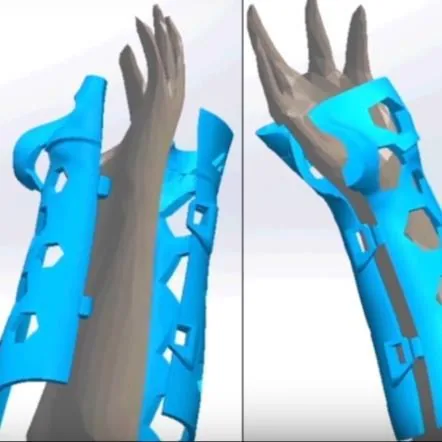
Innovation prototype
Custom 3D-printed brace concept
A prototype demonstrating scan-led customization for arm geometry.
FAQ
Frequently asked questions
Does a scan automatically become editable CAD?
Not always. A scan mesh and an editable CAD model are different deliverables.
What accuracy can you achieve?
It depends on the function, equipment, and part condition, so we confirm it after assessment.
Can you improve the part at the same time?
Yes, when improvement requirements are separated from documentation and agreed in scope.
What information is needed for an existing part?
Provide photos, approximate dimensions, function, worn or damaged areas, mating surfaces and the purpose of the new model.
Can a damaged part be assessed?
We review measurable geometry and missing information. Lost regions are not treated as confirmed measurements; assumptions and verification methods are identified before the model is agreed.
Can a replacement part be fabricated?
Fabrication or printing and fit checks can be added to reconstruction. They are scoped separately from digital-file handover around the part’s function.
What affects cost and timeline?
Surface complexity, access, part condition, critical dimensions, CAD detail and verification requirements determine effort. Estimation follows review of the part or its available information.
How is the reconstructed model checked?
Agreed dimensions and surfaces are compared with the part or reference measurements. A replacement project can include a physical sample and fit check in its proposal.
Next step
Have an idea worth turning into a product?
Send a structured brief so we can review the right path before sensitive details are shared.
What should you include in a quote request?
- Part photos, approximate dimensions, condition and access for inspection.
- The goal: shape documentation, design improvement or a replacement part.
- Critical dimensions, assembly interfaces and required file format.
Handover and testing boundaries
A scan mesh and editable CAD are different deliverables. Measurement and verification requirements follow part assessment. A sample and fit test can be scoped before repeat production.